
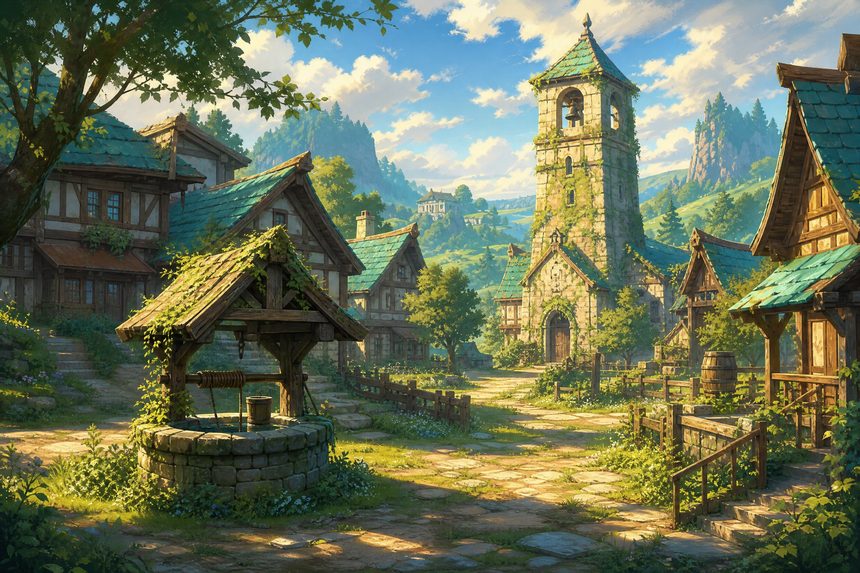
My notes from the first playthrough run to fourteen pages and mention the village on eleven of them. They describe the bell, the light in the late afternoon, the way the paths were slightly overgrown at the edges, and a long passage about how it felt to come back to it after a week away in the mountains.
What they do not mention, at all, in fourteen pages, is the ledger. There is a single line on page nine: ledger screen, fiddly, ignore where possible. That is the entire record of the system that determines every outcome in this game.
What the village actually is
Eleven minutes to cross at a walk. Four buildings you can enter, one of which is a single room. Six named residents, of whom two have more than three lines of dialogue. No shop, no crafting station, no quest board.
I want to be precise about this because the discrepancy is the interesting part. The village is not badly made; it is exactly adequate, and it is doing the job of being somewhere to return to. What it is not is content, and my memory had converted it into the majority of the game because returning is what I remembered feeling.
Memory keeps the feeling and discards the mechanism, and then attributes the feeling to whatever was on screen at the time.
What the ledger is
Every decision in Timber Hollow is entered in a ledger: what was taken from the valley, what was given back, what is owed and to whom. It is presented as an accounting screen, it is genuinely awkward to operate, and it is the only place where the game's rules are visible.
On the first playthrough I avoided it, made decisions intuitively, and completed the game in forty hours with what I recorded as a good ending. On the replay I read it, and discovered that roughly half of what I had understood about the game in 2017 was wrong.
The valley does not recover on a timer, which I had assumed. It recovers in proportion to what the ledger shows as returned, which means the long stretches I spent in the mountains — the stretches my notes describe most fondly — were periods in which the village was quietly deteriorating because nothing was being entered.
| What I believed in 2017 | What the ledger actually does |
|---|---|
| Valley recovers over time | Recovers in proportion to entries returned |
| Residents leave randomly | Leave when their entry stays unbalanced |
| The bell marks the day | The bell rings when a debt is settled |
| Mountain trips are free | Nothing is entered while you are away |
The bell
This is the part I have thought about most. My notes from 2017 mention the bell nine times and describe it as marking the end of the day.
It does not. The bell rings when an entry in the ledger is settled, which happens most often in the late afternoon because that is when the residents finish their work, which is why it appeared to be a clock. Nine years ago I built a whole impression of a place around a sound whose meaning I had inverted.
On the replay, hearing it means something specific and it changes what I do next. It is a better game with the bell understood, and it is a less atmospheric one, and I am not sure the trade favours the second playthrough.
Nine hours shorter
Thirty-one hours this time against forty. Some of that is competence and some of it is that I no longer spend an hour walking around a village that has four rooms in it.
But the largest part is that a game played with its central system understood is much more efficient, and efficiency is not obviously what this game wanted from me. The first playthrough was longer, wronger and considerably more affecting. The second was correct.
| Measure | First playthrough | Replay |
|---|---|---|
| Duration | Forty hours | Thirty-one hours |
| Ledger consulted | Almost never | Constantly |
| Residents remaining | Four of six | Six of six |
| Notes taken | Fourteen pages | Five pages |
What holds up
The valley does. Not the village but the space around it, which is generous, quiet and almost entirely unmarked, and which no amount of understanding the ledger diminishes. Nine years of open worlds full of icons have made this game's emptiness look like a decision rather than a limitation.
What does not hold up is the presentation of the ledger, which is a genuine design failure. A system this important should not be this easy to avoid for forty hours, and the fact that a player can finish the game with a good ending while misunderstanding its central mechanism is not a compliment to either of us.
Where the replay leaves it
A better game than I thought and a worse memory than I had. The valley is the achievement, the ledger is the game, and the village is a small warm room that nine years of remembering had expanded into a country. I would not trade the first playthrough for the second.